
The Theory
Explore original movement models: rotation, force, geometry, gait, and perception.
Explore the theoryExplore the relationships between rotation, force, geometry, perception, and the human body.
You are the whirlwind.
Every body is a spinning celestial body, coiling, orbiting, and releasing force through space.
Helix Theory Training explores the relationships between rotation, geometry, force, perception, and human movement. Discover original models, develop practical skills, and explore the tools designed to support them.
Explore original movement models: rotation, force, geometry, gait, and perception.
Explore the theory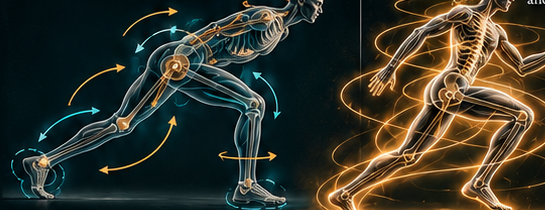
Turn principles into practice through progressive learning, workshops, and training systems.
Explore education
Discover purpose-built training tools and the movement principles that inform their design.
Discover tools
Rotational Strength. Fascial Intelligence. True Leverage.
The human body moves in spirals, not lines. Built on Helix Theory, with the patent-pending Helix Handle, the Helix Mace turns every swing into a lesson in rotation. Made in the USA from premium hardwood.
$119.99
Shop the Helix MaceHuman movement emerges from relationships between geometry, force, rotation, and perception. Helix Theory explores these relationships as an interconnected system, connecting mechanical principles with physical experience.
Rotation is fundamental to the way the human body moves through space. From the spiraling relationships of the spine to the coordinated movement of the limbs, rotational mechanics influence how force is generated, transmitted, and redirected. Helix Theory examines movement through interconnected rotational relationships rather than isolated muscles or linear actions.
Learn moreMovement is shaped by interacting forces. Helix Theory explores six practical force concepts: Convergence, Expansion, Swing, Catch, Coil, and Gait. These describe different ways the body can organize, absorb, redirect, and express mechanical energy through movement.
Learn moreGeometry provides a framework for studying movement relationships. The Prime Kite, Golden Triangle, Prime Line, and Gait Map are geometric models developed within Helix Theory to explore orientation, alignment, spatial relationships, and the organization of the body during movement.
Learn moreMovement depends on more than mechanical output. The nervous system continuously interprets sensory information about weight, pressure, compression, joint position, ground contact, lag, and recoil. Helix Theory investigates how awareness of these sensations can influence coordination, adaptability, and movement skill.
Learn more


